

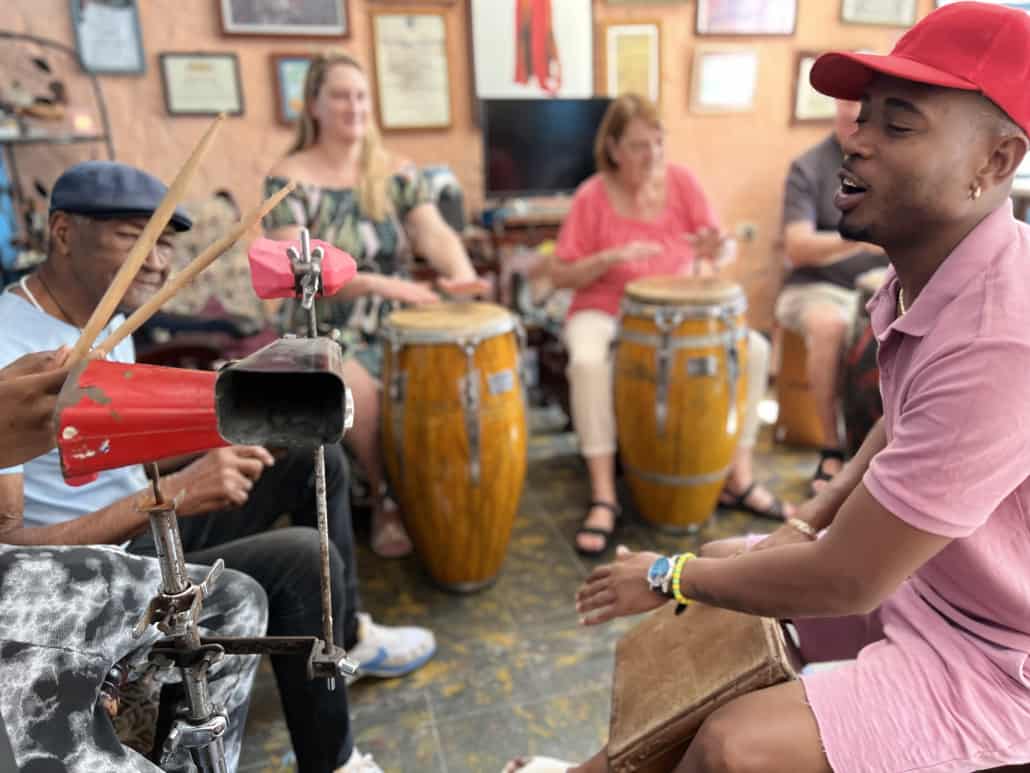
Matanzas occupies a central place in the history of Cuban rumba. Its singers, percussionists and dancers have developed and transmitted the tradition through families, neighborhood gatherings and professional ensembles. Havana Music Tours visits Matanzas several times a year. Our encounters at the home and community space of Los Muñequitos de Matanzas offer opportunities to learn directly from its musicians and observe the exchange of knowledge between generations.
Rumba combines percussion, singing and dance with improvisation and collective participation. Understanding its development in Matanzas requires attention to the city’s Afro-Cuban history and the social settings in which the music has been practiced.
Matanzas and the Afro-Cuban roots of rumba
About 100 kilometers east of Havana, Matanzas is one of the great historical centers of Afro-Cuban music. During the nineteenth century, the region’s port and sugar economy were deeply tied to slavery. Africans brought forcibly to Cuba and their descendants preserved, adapted and transformed musical, religious and social traditions under extraordinarily difficult conditions.
In communities including La Marina, Simpson and Pueblo Nuevo, music became part of neighborhood gatherings, celebrations and everyday social life. Rumba grew in this environment, especially across Afro-Cuban communities in Matanzas and Havana in the late nineteenth and early twentieth centuries. It was not invented by one person, nor does its history belong exclusively to either city.
Early rumba accompaniment included wooden boxes or cajones, handclaps, household objects and other forms of improvised percussion supporting singing and dance. The music offered an expressive space for working-class communities whose cultural contributions were frequently marginalized.
As UNESCO’s account of Cuban rumba makes clear, it is not only a musical genre but a set of community practices passed between generations. Matanzas remains one of the places where those practices can be understood in their social context.
Musical structure: percussion, singing and dance
Rumba is built on relationships. The clave provides a rhythmic framework. The lower-pitched salidor and middle drum, often called tres dos or tres golpes, establish interlocking patterns. The higher-pitched quinto improvises above them, frequently answering the dancer’s movements. Meanwhile, the lead singer and coro (chorus) exchange phrases, jokes, observations and stories.
The three best-known styles reveal different sides of the tradition. Yambú is usually slower and more restrained, with a characteristic couple’s dance. Guaguancó brings a lively dialogue between dancers, including the symbolic vacunao. Columbia is known for rhythmic complexity and virtuosic solo dancing; historically associated with male dancers, it is also performed by women today.
The way a rumba unfolds also depends on its setting. In an informal gathering, singers can take turns and participants can move between listening, playing and dancing; a concert arrangement presents the music differently. In his research on contemporary rumba, ethnomusicologist Johnny Frías distinguishes these informal settings from staged performances and commercial recordings. This matters when listening to Matanzas rumba: a polished recording is one expression of the tradition, rather than a fixed model for every gathering.
Los Muñequitos de Matanzas: origins and musical development
Few ensembles are more closely associated with this history than Los Muñequitos de Matanzas. Founded on October 9, 1952, the group began as Guaguancó Matancero, formed by local rumberos connected to La Marina and neighboring communities.
A frequently retold account places its beginnings around an informal gathering at the El Gallo bar, where young musicians accompanied a recording using tables, glasses and bottles. The story has become part of the group’s history because it conveys how naturally musical ideas could emerge from a social gathering. The group soon became more organized, recording and performing beyond Matanzas.
The name Los Muñequitos came from the popularity of one of its early songs, a reference to comic-strip characters known in Cuba as muñequitos. The public began calling for the group by the song’s name, and the name endured. The Directorio de la Música Cubana records the ensemble’s founding and its early development.
Los Muñequitos’ importance is also musical. Their guaguancó balances a melodic opening, often sung in two voices, with a later section in which a lead singer improvises against the chorus’s repeated response. The relationship between vocal phrasing and carefully balanced percussion is central to their sound. Across generations of performers, the ensemble has maintained older repertoire while incorporating songs about its members’ own experiences.
Grupo Afrocuba de Matanzas is another essential part of this history. The Smithsonian Folkways liner notes for Cuba in Washington describe the ensemble’s role in bringing together the province’s different folkloric forms. Its work places rumba within a wider regional repertoire. These traditions have connections through musicians and communities, but their rhythms, functions and performance contexts should not be treated as interchangeable.
“Estrellas de la Rumba Matancera: Con la bandera en la mano.” Film: El Almacén, the project of our collaborator, musician and producer Luis Bran.
Transmission across generations
Rumba is transmitted through observation, imitation and sustained participation, alongside formal teaching. Percussionists learn to coordinate their patterns and respond to dancers; singers develop phrasing, repertoire and the relationship between the solo voice and chorus. These skills involve knowledge of musical conventions and the ability to respond during performance.
Our own photographs and recordings from Los Muñequitos’ home and community space document younger performers sharing the room with experienced musicians. The gathering brings the music’s history into a practical setting: people singing, playing and learning together.
The Ramos family offers a concrete example of this continuity. In the performance below, children and grandchildren of Diosdado Ramos, the dancer and longtime director of Los Muñequitos, perform El Tonelero. Singing, percussion and chorus are shared across members of the family.
“Familia Ramos – El Tonelero.” Film and original artist credits: El Almacén / #musicacotidiana.
Preserving a tradition does not require every generation to reproduce it exactly as it was performed decades earlier. Young musicians bring their own phrasing and energy while learning the underlying language from those who came before. The tradition remains recognizable because that dialogue continues.
In 2016, UNESCO inscribed rumba in Cuba on its Representative List of the Intangible Cultural Heritage of Humanity. The recognition acknowledged the music, dance and community relationships that sustain it. Safeguarding this heritage depends on continued practice, teaching and transmission within its communities.
Matanzas in the wider history of Cuban rumba
Recordings and concerts have carried Matanzas rumba to international audiences. Hearing practitioners explain a rhythm, discuss a song or remember the people who taught them adds another dimension: the families and neighborhood relationships behind the performance.
That is why Matanzas has been part of Havana Music Tours’ musical journeys. Our past visits with local artists, including Los Muñequitos de Matanzas, have given travelers opportunities to listen and learn directly from practitioners, while allowing us to document aspects of the tradition in their own voices.
Readers interested in exploring the wider musical context can start with our introduction to Cuban rumba or discover the Cuban Jazz & Rumba Tour, which includes Matanzas as part of its itinerary. Specific encounters with artists depend on arrangements and availability.
Above all, this story belongs to the communities that created rumba and to the musicians and dancers who continue carrying it forward.
In memoriam: El Niño Pujada
Rafael Navarro Pujada, known as El Niño Pujada, died in Matanzas on November 7, 2026. His singing was part of Los Muñequitos’ sound for decades. Remembering him means recognizing the individual musicians whose voices and knowledge have shaped the history of Matanzas rumba.
El Niño Pujada with musicians of different generations at the home and community space of Los Muñequitos de Matanzas. Video: Havana Music Tours.
In the recording below, he performs a rumba composed by Julián Mesa alongside Ana Pérez, a singer and dancer with Los Muñequitos, and percussionist Orlando Álvarez, “El Yamba,” of Afrocuba de Matanzas. Listening to these artists together offers a direct way to remember Pujada’s work and the musical community of which he was part.
“Recogidito,” published February 5, 2020. Film and original artist credits: El Almacén / #musicacotidiana.
We extend our condolences to his family, his fellow musicians in Los Muñequitos de Matanzas and the wider rumba community.