

In Cuba, a good phrase can travel almost as far as a good song. Someone says something funny, a singer puts it in a chorus, and before long you hear it at a party, in a conversation, or from somebody who may not even remember the recording.
But which came first: the expression or the song? Juan Formell, the founder of Los Van Van, had a particularly good answer. In a 2000 interview with BOMB, he explained that sometimes he borrowed expressions from everyday Cuban speech, and sometimes his lyrics supplied new ones. The traffic went both ways.
That exchange is worth listening for. These are not all examples of slang invented by musicians. Some words were already familiar, some belong to the working language of music, and others became famous through particular performances. Together, they tell us something about how Cubans listen, joke, dance, and talk.
When the street gets a chorus
“Échale salsita”: a little seasoning goes a long way
Tell a cook to echarle salsita and you are asking for a little sauce or seasoning. In the hands of composer Ignacio Piñeiro, the phrase became a memorable son. The Septeto Nacional recorded “Échale salsita” in the early 1930s, decades before salsa became the familiar international name for a family of dance-music styles.
The musical joke works because sabor is not limited to the kitchen. Musicians also use it to talk about an appealing quality of phrasing, rhythm and performance. Listen as the sung lines give way to a more repetitive, conversational montuno, where the chorus, lead singer and instruments trade ideas. That back-and-forth is part of the pleasure of son.
The 2023 video below, produced by the Cuban label Producciones Colibrí, revisits the classic song with the present-day Septeto Nacional and pays homage to earlier Cuban film history. It is a contemporary tribute, not original 1930s footage. And despite its title, this composition did not single-handedly give the later salsa genre its name.
“El manisero”: when a vendor’s call became a hit
Strictly speaking, “El manisero” is not slang. It belongs to another fascinating category: the pregón, the melodic sales call of a street vendor. The composer Moisés Simons transformed the sound and language of a peanut seller into one of Cuba’s most internationally influential songs.
Rita Montaner recorded it in 1927. Don Azpiazú and his Havana Casino Orchestra followed in 1930 with a version that helped introduce Cuban popular music to a broad United States audience. The Library of Congress recognizes both recordings in its National Recording Registry.
What makes a pregón so musical? The vendor needs a call that people can recognize from a distance. Repetition, melodic contour and a recognizable phrase do much of the work. Once adapted into a song, an everyday sound becomes something listeners can sing back.
Hear the history: listen to Rita Montaner’s “El manisero” through the Library of Congress. The recording is listed under its title.
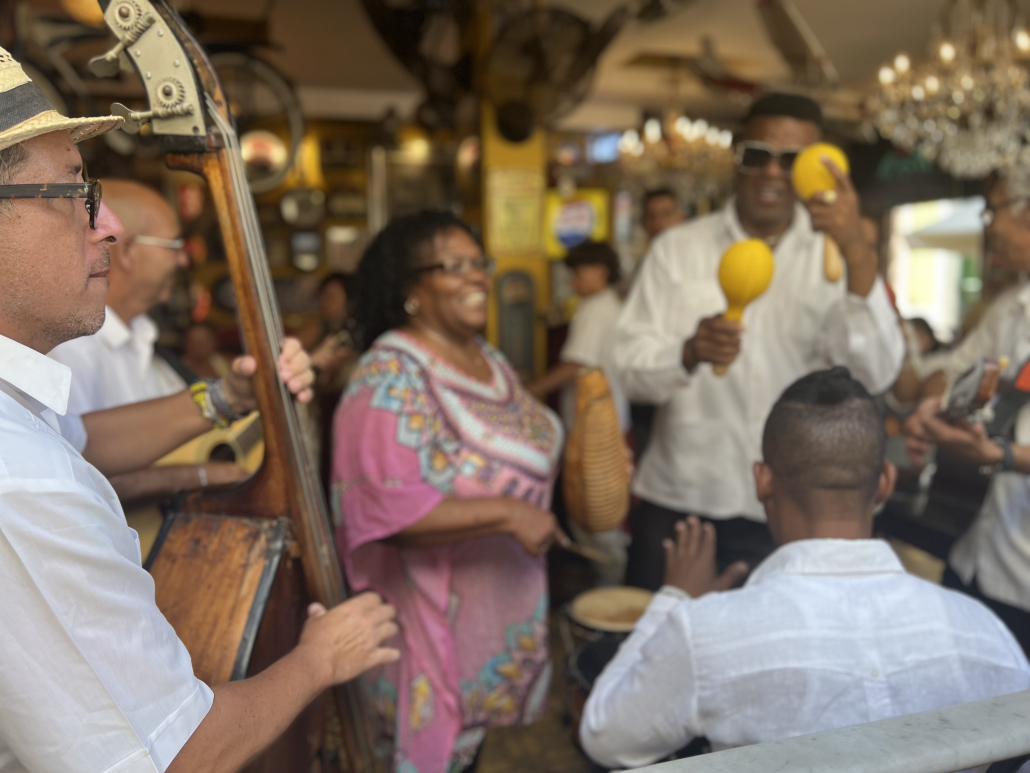
“Eso que anda”: Formell’s genius for catching what people say
What exactly is eso que anda? It depends. It might mean a rumor, a trend, something spreading, or just the thing everybody seems to be talking about. The expression leaves enough unsaid for the listener to fill in the rest.
Formell explained that this ambiguity appealed to him. Another phrase he discussed, y que se sepa (“and let it be known”), has the same wonderfully emphatic quality, even when nobody has specified what should be known. He took such verbal shorthand and turned it into musical storytelling. Los Van Van released “Eso que anda” on their 1986 album of the same name.
There is real musicological interest here. A short, repeatable phrase fits naturally into the coro, the chorus that answers a lead singer during a montuno. The singer can change the context around it, while the audience keeps returning to words everybody knows. Formell was both a composer and an unusually sharp observer of social life.
Listen and explore: Los Van Van, “Eso que anda” (official artist-channel recording). See also Juan Formell’s discography and his interview about the Cuban phrases behind the songs.
When a song comes back into conversation
“Yo soy normal, natural y un poquito acelerado”
This one is particularly funny because the speaker seems to be insisting they are perfectly ordinary, then immediately admits to being a little too fast for their own good. The line became associated with Los Van Van’s “Soy normal, natural.”
In that same BOMB interview, Formell identified the expression as an example of words that moved in the other direction: from his songwriting into ordinary speech. Rather than claiming the phrase came from an anonymous street conversation, he said he had given it to the audience.
The musical setting matters. A compact, rhythmically distinctive line is easy to remember, especially when the chorus repeats it. The idea becomes funny again each time it turns up in a new conversation. That is a different kind of success from a chart position.
Listen / watch: Los Van Van, “Soy normal, natural” (official artist-channel recording).
“¡Azúcar!”: Celia Cruz turns a word into a signature
Sugar is not slang, of course. But try saying ¡Azúcar! without thinking of Celia Cruz. Her famous exclamation is an example of a performer giving an ordinary word a second life.
Cruz herself recalled being asked by a waiter whether she wanted sugar in her Cuban coffee. She repeated the amusing exchange during a performance, and the audience loved it. Eventually, she dropped the story and kept the shout. Her account is preserved by the Celia Cruz Foundation.
Over time, the word carried layers beyond that original joke. The Smithsonian also connects Cruz’s famous call with Afro-Cuban identity and the difficult history of sugar production and enslaved labor. A brief stage exclamation can be playful and culturally meaningful at the same time.
Watch: the Smithsonian’s short explanation of “¡Azúcar!”. It is a helpful companion to Cruz’s performances.
Words with rhythm in their bones
“Tener tumbao”: a groove you can hear and a style you can see
In the language of Cuban ensembles, a tumbao is a recurring rhythmic pattern or groove, often associated with the bass, piano or congas. It is a practical term: a musician might talk about adjusting a bass tumbao or how the piano fits against the percussion.
In everyday conversation, however, tener tumbao can describe somebody with style, confidence or a distinctive way of moving. Musical terminology has crossed into the language of personality. It is an excellent example of how the same word can carry a precise musical meaning and a more figurative social meaning.
Celia Cruz brought those senses together in her 2001 recording “La negra tiene tumbao,” produced by Sergio George. The arrangement draws together Afro-Caribbean rhythmic vocabulary and contemporary popular-music production. Listen to how the repeating instrumental groove supports the vocal phrase, then consider how the title also describes the character of the person being sung about.
“Sandunguera”: when somebody has that particular swing
Sandunga has a longer history in Spanish and is not uniquely Cuban. In Cuban popular usage, it can suggest flair, charm, spirited movement or a certain ease on the dance floor. A sandunguera is somebody who moves with that quality.
Los Van Van turned the word into the center of their 1980s song “Sandunguera,” composed by Juan Formell. Notice how the rhythmic arrangement makes the description feel physical. The song is about movement, but the instrumental parts are moving too: bass, percussion, piano and the rest of the ensemble work together to produce the dance feel.
The later official lyric-video version even folds in the greeting ¿qué bolá?, a familiar Cuban way of saying “what’s up?” It is a nice reminder that a song can remain alive in the spoken language of different generations. We should not mistake the presence of that greeting in a recording for proof that the song invented it.

“Se formó la gozadera”: when words announce the party
When somebody says se formó la gozadera, the fun has started. Gozadera is part of a wider Caribbean vocabulary of enjoyment and celebration, not a phrase we can credit to one musician. It is also a lovely example of how everyday speech already contains a sense of rhythm.
Think about how easily that line becomes a chorus. A singer announces that something is happening; the musicians answer with a groove; the crowd recognizes the invitation. In both traditional dance music and more recent party tracks, familiar expressions can become memorable not because the songwriter invented the words, but because of the way the music makes people want to repeat them.
From the dance floor to the group chat: Cuba’s urban vocabulary
If this story ended with Los Van Van and Celia Cruz, it would miss a huge part of how Cuban language is changing right now. Today, phrases travel not only through songs and dance floors but through WhatsApp, TikTok, YouTube, Instagram, memes, voice notes, and the running conversation between Cubans on the island and abroad. A catchy line can become a caption, a joke among friends, or the kind of phrase you hear repeated everywhere. Sometimes the song borrowed it first; sometimes the record makes it famous.
That exchange is particularly visible in reparto, a distinctive strand of contemporary Cuban urban music that developed in Havana in conversation with reggaetón and local dance-music traditions. Its rhythmic vocabulary can draw on percussion, timba and electronic production in combinations that continue to change. It deserves to be heard on its own terms, rather than treated as interchangeable with either older Cuban son or hip-hop. For more musical context, see TIDAL’s overview of the sound.
The pauta: a punchline, a musical signature, and sometimes a new expression
In contemporary reparto, musicians and listeners often talk about a pauta: a short, distinctive spoken or chanted phrase delivered where the music gives it extra impact. It might be a playful greeting, a joke, or an unexpectedly memorable combination of words. When people recognize and repeat that particular delivery, a moment in a recording can find a second life in everyday conversation.
That is where the musicologist’s question becomes especially interesting. A pauta is not identical to the traditional coro-pregón of son or timba, and the rhythmic structures are different. Yet both make great use of a familiar principle: build anticipation, deliver words people can recognize instantly, and give them a rhythmic shape that is satisfying to repeat. Modern reparto adds the speed of social media to a process Cuban popular music has been exploring for generations.
“¿Qué bolá, asere?”: the greeting that belongs to everybody
¿Qué bolá? is a familiar Cuban way of asking “What’s up?” and asere is a casual way of addressing a friend. Neither expression needed a hit record to exist. But when a singer slips them into an introduction, a chorus or a quick spoken aside, they can give the performance an immediately recognizable conversational character.
The words themselves are only part of it. Pay attention to the timing, the teasing tone, and the little pause before the response. A phrase that sounds ordinary in a conversation can feel like a musical hook when placed against a beat. That is why musicians can work creatively with familiar expressions without claiming to have invented them.
“Está duro”: when a phrase changes with the moment
Here is one of the pleasures of everyday Cuban Spanish: context is everything. Está duro might describe something genuinely difficult, but in another conversation it can be praise for something impressive. The delivery, the situation, and the people speaking tell you what it means. Put a phrase like that in a song and it can take on another layer of humor.
Reparto and other Cuban urban styles often make room for these brief, emphatic expressions. Some appear as a pauta; others become part of a repeating chorus, a dance cue, or an audio clip shared among friends. The interesting part is not simply that a phrase becomes popular. It is how listeners carry it into their own conversations, sometimes changing its meaning as they go.
Cuban rap and the pleasure of wordplay
Cuban hip-hop belongs in the story too, but its use of language often works differently from a short reparto hook. Rap gives an artist room for longer observations, clever rhymes, double meanings, personal stories, affection, jokes and neighborhood detail. A single everyday expression can mean one thing at the beginning of a verse and something richer by the end.
Try listening for where the rapper places the stress in a word, bends a syllable to fit the rhythm, or lets two meanings sit side by side. The payoff is not always a catchphrase that everybody shouts. Sometimes it is a line that makes you smile because you recognize exactly what the artist is describing. That, too, is Cuban language turning into music.
Another modern thread: Cuban rhythms meet electronic music
Reparto and hip-hop are only parts of Cuba’s contemporary music scene. Havana-based producer DJ Jigüe, for example, explores the meeting point between electronic production and Afro-Cuban rhythmic ideas. His track “Electrotumbao” is a particularly fitting listening stop here: even its title shows how a musical word such as tumbao can be carried into a different sound. This is electronic music, not an example of reparto.
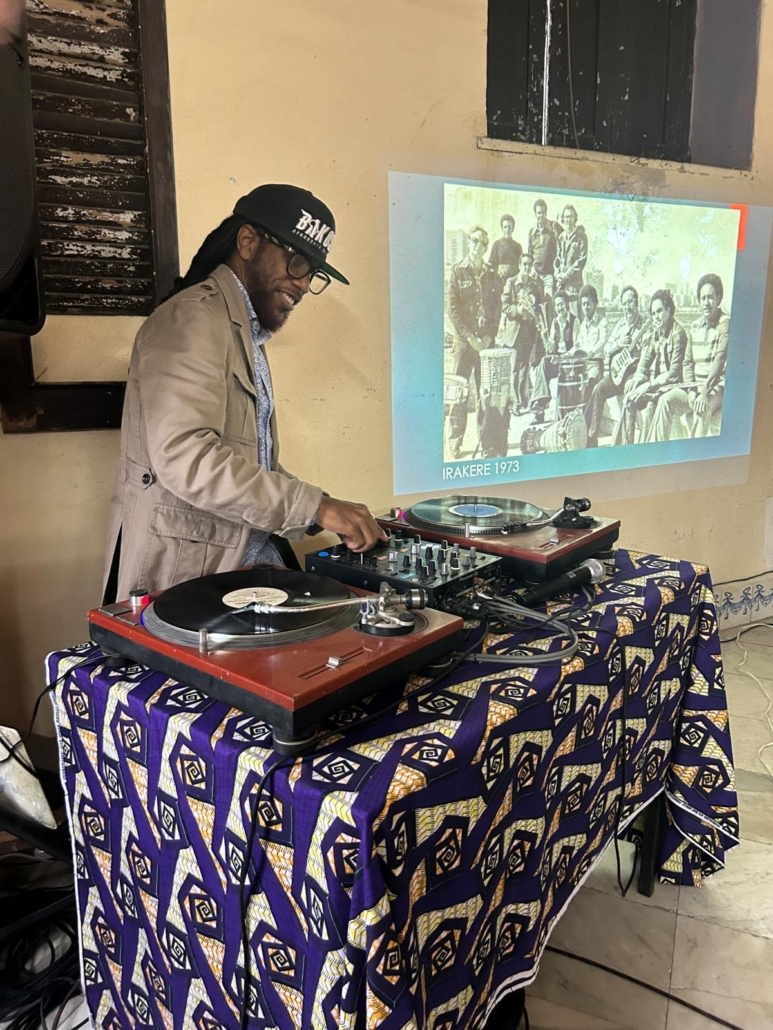
Watch: DJ Jigüe’s “Electrotumbao”, a music video shared by his Guámpara Music channel. The photo above is from a separate Havana Music Tours music experience, not from this video.
A new generation can make the phrase travel faster than the record
The mechanics of circulation are different now. A young listener might encounter a fifteen-second snippet before hearing the full track, learn the accompanying dance, reuse the phrase in a voice note, and only later find out which musician recorded it. Artists can also test whether a line sticks almost immediately by watching people imitate it online. As the Associated Press reported in 2025, musicians working in Cuba increasingly rely on internet platforms, phone-to-phone sharing, and videos to reach audiences.
This does not mean every viral catchphrase becomes lasting slang, or that every new Cuban expression comes from reparto. Trends disappear, meanings shift, and a joke that sounds natural in Havana may land differently elsewhere. But that rapid back-and-forth is exactly the point: the music is not just reflecting spoken language. Young listeners are actively helping decide which musical phrases will enter the next conversation.
As with any living slang, context matters. A greeting that sounds warm between friends can seem odd when lifted out of its setting. Not every phrase travels across generations, neighborhoods or the Cuban diaspora in quite the same way. Instead of treating a song like a fixed dictionary, listen to who says the words, how the line is delivered and what makes other people respond. That is where much of its cultural meaning lives.
Why these expressions stick
There is no single origin story for the words on this list. A pregón becomes a song. A song borrows a street expression. A performer makes a word their trademark. A technical musical term becomes a description of somebody’s personality. A reparto chorus turns a joke into a social-media reference. And, sometimes, a songwriter creates a line that people start using long after the record ends.
In son, songo, salsa and timba, the dialogue between coro and pregón gives a joke, a warning or a snapshot of daily life a place to return to. In reparto, a well-placed pauta can create a different kind of collective response; in rap, the surrounding verse often gives an expression its power. These are distinct musical practices, but each makes language part of the rhythmic experience.
The next time you hear one of these songs, listen beyond the hook. Notice where the singer places a phrase, what the musicians do around it, and which words people remember. Then follow the phrase a little further: into a dance, a meme, a voice note or a joke that suddenly everybody seems to know. That is one way Cuban music keeps a conversation going across generations.
For a broader introduction to the rhythms behind these recordings, read our guide to Cuban music. And if the stories behind the songs are part of what draws you to Cuba, our private Cuba music tours can be shaped around the genres and cultural questions you most want to explore.